
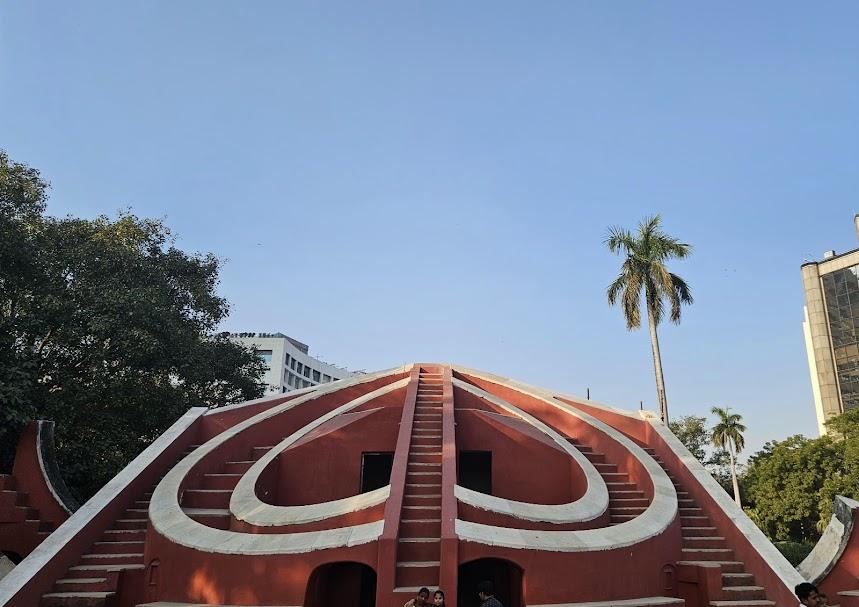
Jantar Mantar, Delhi: Everything You Should Know About
Jantar Mantar in New Delhi is an 18th-century astronomical observatory where large masonry structures were built to measure time and observe the movements of celestial bodies. Located near Connaught Place, it offers a look at how astronomers studied the sky before modern telescopes and electronic instruments became widely available.
Built in 1724 by Maharaja Sawai Jai Singh II, the observatory contains monumental instruments designed for astronomical observations. Their unusual geometric shapes may look abstract at first, but each structure had a specific scientific purpose.
If you are planning a visit, this guide covers Jantar Mantar Delhi timings, entry fees, the nearest metro station, history, major astronomical instruments and practical visitor tips. It also includes a first-hand account of visiting the observatory and suggestions for exploring other heritage sites in central Delhi.
Jantar Mantar Delhi: Quick Visitor Information
| Visitor information | Details |
|---|---|
| Location | Parliament Street, Connaught Place, New Delhi |
| Year of construction | 1724 |
| Built by | Maharaja Sawai Jai Singh II |
| Opening days | All days, according to Delhi Tourism |
| Timings | Sunrise to sunset |
| Entry fee for Indian visitors | ₹25 |
| Entry fee for foreign visitors | ₹300 |
| Photography | Photography charges are listed as nil |
| Video filming | ₹25, according to Delhi Tourism |
| Nearest metro station | Patel Chowk |
| Recommended visit duration | Around 45 minutes to 1 hour |
| Best time to visit | Early morning or late afternoon, depending on the season |
Important: Timings and ticket prices can change. The details above follow the Delhi Tourism visitor listing; confirm the current information through the official listing or the ticket counter before travelling.
Official visitor information: Delhi Tourism — Jantar Mantar.
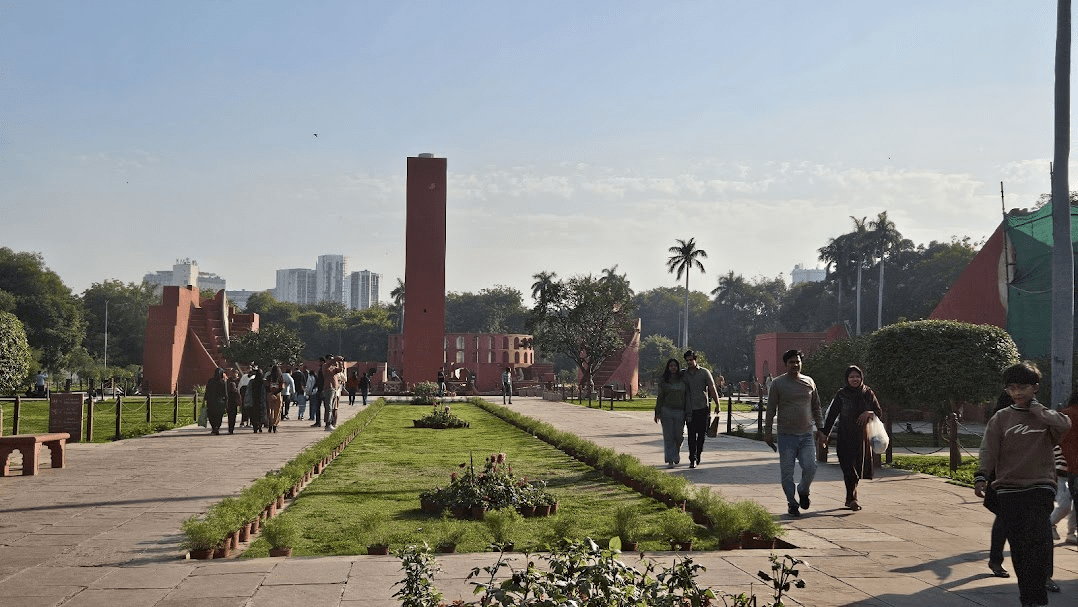
Where Is Jantar Mantar in Delhi?
Jantar Mantar is situated on Parliament Street, close to Connaught Place in central New Delhi. Its location makes it convenient to combine a visit with other attractions around the city centre.
How to reach Jantar Mantar
By Metro: Patel Chowk on the Yellow Line is the metro station identified by Delhi Tourism as the nearest station. Depending on your starting point, you can compare metro routes and the walking distance from other central Delhi stations.
By Taxi or Cab: You can enter Jantar Mantar, Parliament Street, New Delhi, as your destination in your preferred navigation app.
By Bus: Check current Delhi bus routes for services stopping near Connaught Place or Parliament Street.
If you are visiting several attractions in one day, plan the route beforehand. India Gate, Agrasen Ki Baoli and Connaught Place can be considered for a wider central Delhi heritage itinerary, although travel time will depend on traffic and your chosen route.
Jantar Mantar Delhi Timings and Entry Fee
One of the most common questions visitors ask is: What are the opening and closing times of Jantar Mantar in Delhi?
Delhi Tourism lists the observatory as open every day, from sunrise to sunset. This is a better reference than assuming that the site always opens at 6 AM and closes at 6 PM, since daylight hours vary throughout the year.
Jantar Mantar Entry Fee
Delhi Tourism lists the following charges:
- Indian visitors: ₹25
- Foreign visitors: ₹300
- Photography: No separate charge listed
- Video filming: ₹25 listed
These are published visitor details, not a guarantee of the price charged on your visit date. Check the current ticket counter information before travelling, particularly if you are visiting with a group.
How long does it take to explore Jantar Mantar?
Allow approximately 45 minutes to one hour for a general visit. You may want more time if you are particularly interested in astronomy, architecture or photography.
The site is easier to appreciate when you understand what the instruments were designed to measure. Instead of walking past the structures as unusual monuments, look at their scales, angles, walls and openings and consider how they were used to observe the sky.
History of Jantar Mantar, Delhi
Jantar Mantar was built in 1724 under Maharaja Sawai Jai Singh II, the ruler of Amber who later founded Jaipur. He was interested in astronomy and wanted more reliable observations of celestial positions than he believed the instruments available to him could provide.
The observatory was designed around large, fixed instruments. Their size and carefully calculated geometry helped observers measure the positions and movements of celestial bodies using direct observation.
Jai Singh II established a network of observatories across northern India. Besides Delhi, the sites associated with his observatories include Jaipur, Ujjain, Varanasi and Mathura. The observatories differed in their layouts, sizes and instruments.
The Delhi observatory is therefore part of a broader history of astronomical study in 18th-century India. It demonstrates how rulers, scholars and astronomers used architecture and mathematical principles to investigate the sky.
Why was Jantar Mantar built?
Jantar Mantar was built to support astronomical observations and calculations. Its instruments were intended to help observers study the position of the Sun and stars, measure time and determine celestial coordinates.
At the time, astronomical observations were relevant to calendar-making, timekeeping and traditional astronomical calculations. The observatory also reflected the scientific interests and authority of its royal patron.
The structures were not designed as decorative monuments alone. Their shapes, orientations and measurement scales were integral to their function.
Is Jantar Mantar Delhi a UNESCO World Heritage Site?
No. The UNESCO World Heritage Site is Jantar Mantar in Jaipur, Rajasthan, not the observatory in Delhi.
UNESCO inscribed the Jaipur observatory on the World Heritage List in 2010. The Delhi observatory is a historically significant monument in its own right, but it should not be described as a UNESCO World Heritage Site.
For verification, see the UNESCO World Heritage Centre’s entry for Jantar Mantar, Jaipur.
This distinction matters because the two observatories share a name and historical connection but are separate sites.
The Astronomical Instruments at Jantar Mantar Delhi
The most distinctive feature of Jantar Mantar is its collection of large astronomical instruments, known as yantras. These structures were designed to turn observations of the sky into measurable information.
Here are four of the best-known instruments described in connection with the Delhi observatory.
| Instrument | Main purpose | What to look for when visiting |
|---|---|---|
| Samrat Yantra | A large equinoctial sundial used to determine local solar time and support astronomical measurements | Its enormous triangular gnomon and curved, graduated structures |
| Rama Yantra | Measures the altitude and azimuth of celestial objects | The cylindrical arrangement, open centre and measurement markings |
| Jai Prakash Yantra | Helps determine the positions and coordinates of celestial bodies | The concave, hemispherical surfaces and their markings |
| Misra Yantra | A combination of instruments designed for specific astronomical calculations, including determining noon and comparing solar observations | The combination of intersecting geometric structures |
The exact collection and layout of instruments differ between Jai Singh II’s observatories. If you compare photographs of Delhi and Jaipur, you will notice that the two sites are not identical.
1. Samrat Yantra
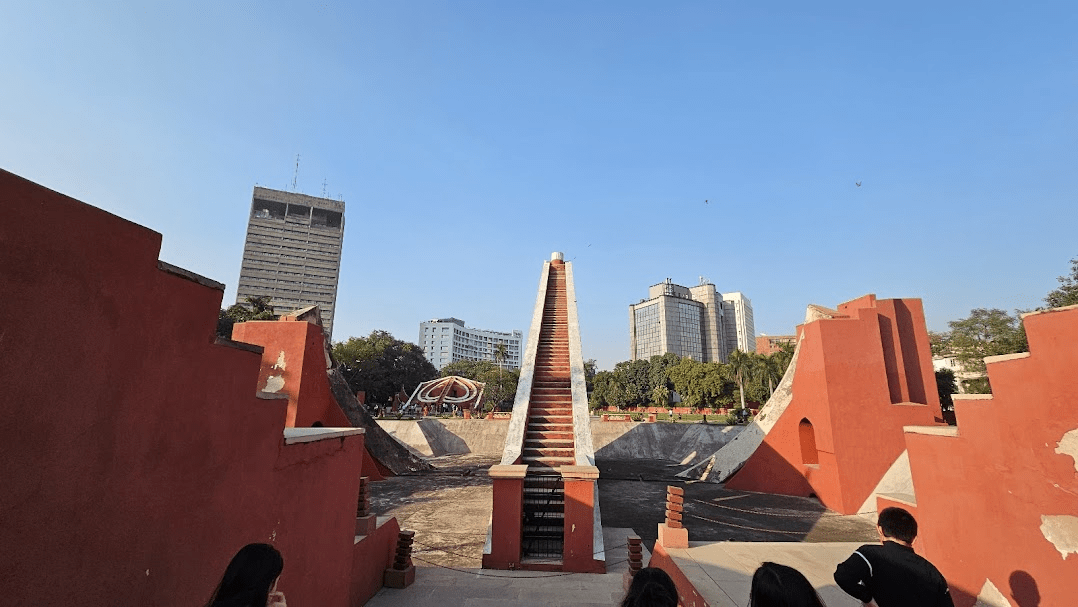
The Samrat Yantra is one of the most recognisable structures at Jantar Mantar. Its large triangular gnomon works with graduated surfaces to help determine local solar time.
A sundial works by relating the position of a shadow to the movement of the Sun. The Samrat Yantra takes this principle to a monumental scale.
When looking at the structure, pay attention to the angle of the central wall and the curved surfaces alongside it. These are not arbitrary architectural choices; they form part of the instrument’s measuring system.
2. Rama Yantra
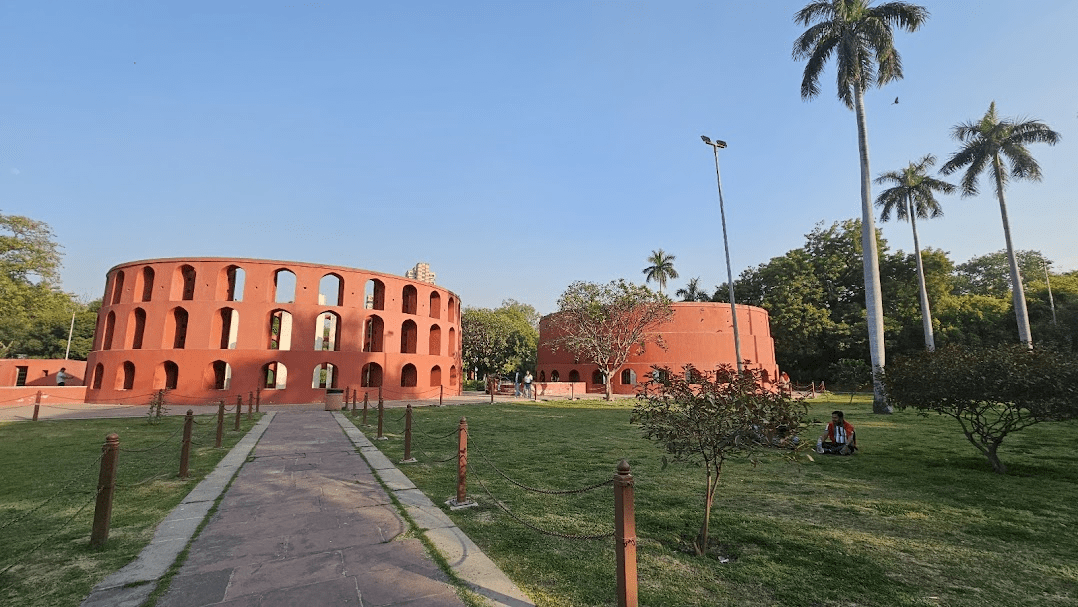
The Rama Yantra was designed to measure the altitude and azimuth of celestial objects. Altitude describes how high an object appears above the horizon, while azimuth describes its direction along the horizon.
The instrument’s cylindrical arrangement and open centre allow observers to relate the position of a celestial object to markings on the structure.
Its design illustrates how an astronomical instrument could be built into a permanent architectural form.
3. Jai Prakash Yantra
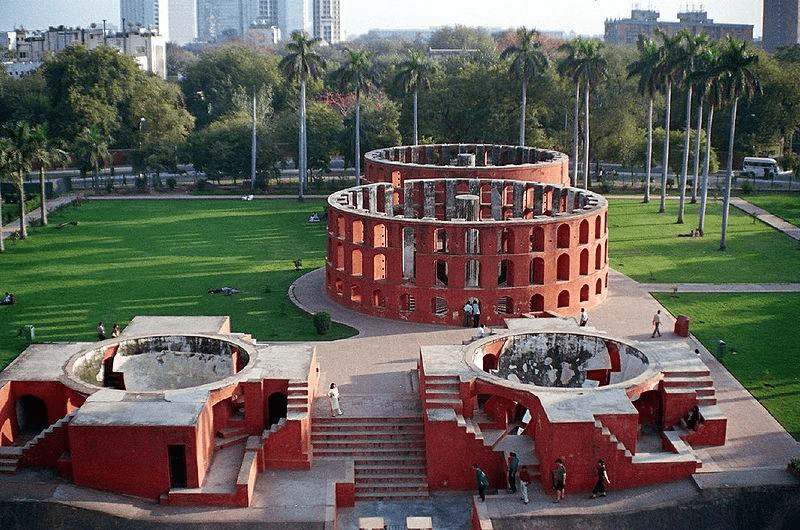
Image source: Indiamart.com
The Jai Prakash Yantra uses concave, hemispherical surfaces with markings to help establish the positions of celestial objects.
The geometry of the instrument allows observations to be related to a coordinate system. Its unusual shape makes more sense once you understand that the curved surface is part of the measuring apparatus.
Rather than seeing it simply as a hollow structure, look at how the markings and shape work together.
4. Misra Yantra
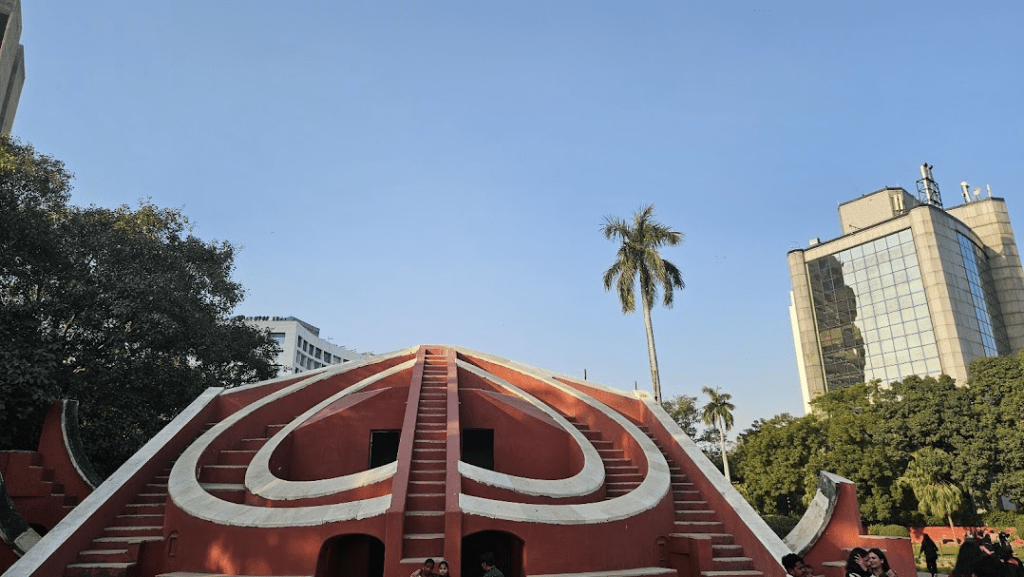
The Misra Yantra combines several elements to support different astronomical calculations. It was designed for specific observational tasks, including determining noon and comparing solar measurements.
Its arrangement differs from the simpler appearance of a conventional sundial. The combination of structures reflects the range of calculations that historical astronomers wanted to carry out.
What do the instruments tell us about Indian astronomy?
The yantras demonstrate the relationship between mathematics, astronomy and architecture in early modern India.
They also show that scientific instruments do not always resemble the devices we use today. Before electronic sensors and digital displays, observers relied on carefully designed physical structures, calibrated markings and systematic observations.
The observatory is especially interesting because its instruments make the process of measurement visible. Their size and geometry are part of the scientific method for which they were designed.
My Personal Experience Visiting Jantar Mantar in Delhi
During my visit to Jantar Mantar in February, I went in the late afternoon. The crowd was moderate: there were enough people to make the place feel lively, but it was not overwhelmingly busy.
One advantage of the location is that you can combine the visit with other places around central Delhi. India Gate is a useful addition to a wider sightseeing plan, while Connaught Place is nearby for a meal or a walk around the city centre.
I also found that photography required a little patience. During my weekend afternoon visit, people sometimes moved into the frame, making it harder to take clear photographs of the instruments.
My suggestion is to consider an early weekday visit if photography is one of your priorities. Softer morning light can help with architectural photographs, and you may have a better chance of capturing the structures without large groups of visitors in the frame.
Keep in mind that crowd levels vary by day and season. These observations describe my own visit rather than a guarantee of what you will experience.
Best Time to Visit Jantar Mantar Delhi
The best time depends on whether you are more interested in comfortable sightseeing, photography or exploring the site in detail.
Best time of day
Early morning and late afternoon are good starting points because Delhi can become uncomfortable during the hotter part of the day. Check the current opening hours and leave enough time before sunset.
If you want photographs without too many people in the background, a weekday morning may be worth considering.
Best time of year
The cooler months, particularly November to March, are generally more comfortable for walking around Delhi’s outdoor heritage sites.
Summer afternoons can be hot, so carry water for the journey and check local weather conditions. During the monsoon, consider the possibility of rain and wet walking surfaces.
Tips for Visiting Jantar Mantar
A little preparation can make the visit more rewarding.
- Check the current timings and ticket price. Use Delhi Tourism’s listing as a starting point, then confirm details before leaving.
- Visit early if you prefer quieter surroundings. Weekday mornings may also be more convenient for photography.
- Read about the instruments beforehand. Knowing what the Samrat Yantra, Rama Yantra and Jai Prakash Yantra measure makes the structures easier to understand.
- Wear comfortable footwear. You will be walking around an outdoor monument.
- Respect the structures. Avoid climbing on instruments or touching restricted areas.
- Check photography rules at the entrance. Delhi Tourism lists no separate photography charge and a charge for video filming; confirm the current rules on arrival.
- Plan nearby attractions sensibly. India Gate, Agrasen Ki Baoli and Connaught Place can be considered for a broader itinerary, but allow for transport time.
Is Jantar Mantar Delhi suitable for children?
It can be a useful visit for children who are interested in science, history, architecture or astronomy. The instruments provide a visual way to introduce ideas such as shadows, angles, timekeeping and the apparent movement of celestial bodies.
Younger visitors may benefit from a simple explanation before the visit. For example, ask them to notice how the Samrat Yantra uses a shadow to help measure time.
Is Jantar Mantar accessible to visitors with mobility needs?
Accessibility can depend on the paths, surfaces and areas open during your visit. The information reviewed for this guide does not establish the current accessibility arrangements in sufficient detail to make a blanket claim.
If you need step-free access or other specific facilities, contact the site or check with the ticket counter before travelling.
Interesting Facts About Jantar Mantar Delhi
- Built in 1724: The Delhi observatory dates to the reign of Maharaja Sawai Jai Singh II.
- One of five observatories: It belongs to a network of observatories established under Jai Singh II at Delhi, Jaipur, Ujjain, Varanasi and Mathura.
- Built for observation: Its geometric structures were designed as instruments for astronomical measurements.
- Different from Jaipur: The Delhi and Jaipur observatories have different layouts and collections of instruments.
- Part of India’s scientific heritage: The site offers a physical record of astronomical practices in 18th-century India.
- Close to central Delhi attractions: Its location near Connaught Place makes it convenient to include in a wider heritage itinerary.
Nearby Places to Visit
If you have more time in central Delhi, consider combining Jantar Mantar with one or two other attractions.
| Place | Why visit |
|---|---|
| Connaught Place | Explore the historic commercial district, shops, cafés and restaurants |
| India Gate | Visit one of Delhi’s best-known national monuments and surrounding public spaces |
| Agrasen Ki Baoli | See a historic stepwell with distinctive architectural features |
| National Museum | Explore collections related to Indian art, archaeology and history; check current visitor information before planning your visit |
Choose the order according to your starting point, available time and transport arrangements rather than assuming that every attraction is a short walk away.
Frequently Asked Questions About Jantar Mantar Delhi
1. What are the timings of Jantar Mantar Delhi?
Delhi Tourism lists Jantar Mantar as open every day from sunrise to sunset. Confirm the current opening arrangements before your visit.
2. What is the entry fee for Jantar Mantar Delhi?
Delhi Tourism lists an entry fee of ₹25 for Indian visitors and ₹300 for foreign visitors. Check the current price at the official listing or ticket counter, as fees may change.
3. Which metro station is nearest to Jantar Mantar?
Patel Chowk on the Yellow Line is the metro station listed by Delhi Tourism as the nearest to Jantar Mantar. Check your route and walking directions before travelling.
4. How much time is needed to visit Jantar Mantar?
Around 45 minutes to one hour is a reasonable estimate for a general visit. You may need longer if you want to study the instruments or take photographs.
5. Who built Jantar Mantar Delhi?
Maharaja Sawai Jai Singh II commissioned the observatory in 1724. He established several observatories to support astronomical observations and calculations.
6. Why was Jantar Mantar built?
It was built to observe celestial bodies and support measurements of time and astronomical positions. Its instruments used geometry and direct observation to produce measurements.
7. Is Jantar Mantar Delhi a UNESCO World Heritage Site?
No. Jantar Mantar in Jaipur is the UNESCO World Heritage Site. The Delhi observatory is a separate historical monument.
8. What is the Samrat Yantra used for?
The Samrat Yantra is a large sundial used to determine local solar time and support astronomical measurements.
9. Is photography allowed at Jantar Mantar?
Delhi Tourism lists photography charges as nil and a separate fee for video filming. Confirm the rules at the site before taking photographs or recording video.
10. What is the best time to visit Jantar Mantar?
Early morning or late afternoon can be more comfortable than the hottest part of the day. The cooler months are generally better for exploring Delhi’s outdoor monuments.
11. Can Jantar Mantar be combined with India Gate?
Yes. You can include both in a central Delhi sightseeing plan, but account for the distance and traffic when arranging your route.
12. What should I look for at Jantar Mantar?
Look at the Samrat Yantra, Rama Yantra, Jai Prakash Yantra and Misra Yantra. Understanding their purposes makes the visit more meaningful than simply viewing the structures as architectural curiosities.
Final Thoughts
Jantar Mantar Delhi is a reminder that astronomy, mathematics and architecture have long been connected in India’s scientific history. Built in 1724, its instruments were designed to make observations of the sky possible through carefully calculated structures and markings.
For visitors, the site offers more than unusual shapes and impressive masonry. It provides an opportunity to understand how astronomers measured time and celestial positions before modern instruments became commonplace.
If you are exploring Delhi’s history, Jantar Mantar is worth considering alongside other heritage attractions in the city. Take time to understand the instruments, keep the practical visitor information handy and, if you enjoy photography, consider visiting early on a weekday.
Official visitor information: Delhi Tourism — Jantar Mantar
Further reading: UNESCO World Heritage Centre — Jantar Mantar, Jaipur
You can read more about the yantras at https://www.jantarmantar.org/

Khushi Jha
I am Khushi Jha, a proud alumna of Delhi University with a degree in History and Political Science. My fascination with the events that have shaped our world drives me every day. Currently, I am pursuing my Master’s in History, diving even deeper into global dynamics and the incredible heritage of India. I firmly believe that India's rich heritage deserves wider recognition. I strive to bring its stories to the forefront, ensuring they are celebrated and acknowledged on a global stage. I have written extensively across various niches, including fashion, health, lifestyle, real estate, hospitality, amongst others. In my free time, you’ll find me immersed in books, both fiction and non-fiction, or simply enjoying some much-needed rest.

You May Also Like

Onam 2025: Date, History, Significance, Traditions, and Celebrations

Raksha Bandhan 2026: Date, Muhurat, History, Rituals & Celebration Guide