Navratri 2026: Dates, Colours, Traditions and Celebrations Across India
Quick Answer
Navratri 2026 begins on October 11 and ends on October 19. The popular nine-day colour sequence is Orange, White, Red, Royal Blue, Yellow, Green, Grey, Purple and Peacock Green. Vijayadashami, or Dussehra, falls on October 20, 2026.
Navratri is one of India’s major Hindu festivals and is observed over nine nights in honour of Goddess Durga and different forms of Shakti, the divine feminine power. Sharad Navratri, the autumn Navratri, is celebrated across India, but the festival does not look the same everywhere. In Gujarat, people gather for Garba and Dandiya. In West Bengal, Durga Puja becomes the centre of the festival season. Mysuru celebrates Dasara with its own royal and religious traditions, while Tamil Nadu and Kerala follow distinctive customs connected with Golu, Saraswati worship, and learning.
For anyone planning to celebrate or travel during Navratri 2026, the first thing to know is the calendar. Navratri begins on October 11 and ends on October 19. Dussehra follows on October 20. This guide covers the 2026 dates, nine colours, forms of Durga, rituals, fasting traditions, regional celebrations, Garba, Durga Puja, and the best places to experience the festival across India.
Key Facts
| Detail | Navratri 2026 |
|---|---|
| Festival | Sharad Navratri |
| Start date | October 11, 2026 |
| End date | October 19, 2026 |
| Duration | Nine nights |
| Vijayadashami / Dussehra | October 20, 2026 |
| First day | Ghatasthapana / Pratipada |
| Main deity | Goddess Durga and forms of Shakti |
| Popular 2026 colours | Orange, White, Red, Royal Blue, Yellow, Green, Grey, Purple, Peacock Green |
| Major regional celebrations | Gujarat, West Bengal, Odisha, Karnataka, Tamil Nadu, Kerala, Maharashtra and North India |
Table of Contents
- Navratri 2026 dates
- Navratri 2026 colours
- Why do Navratri colours change every year?
- The nine forms of Goddess Durga
- What is Navratri and why is it celebrated?
- Navratri and Durga Puja
- How Navratri is celebrated across India
- Common Navratri rituals
- Navratri fasting and food
- What to wear during Navratri
- Best places to experience Navratri in India
- Navratri 2026 travel tips
- Frequently asked questions
Navratri 2026 Dates
According to the official Incredible India festival listing, Sharad Navratri 2026 runs from Sunday, October 11, to Monday, October 19. The nine-day observance is followed by Vijayadashami on Tuesday, October 20.
Navratri 2026 calendar
| Day | Date | Popular Colour |
|---|---|---|
| Day 1 | October 11, Sunday | Orange |
| Day 2 | October 12, Monday | White |
| Day 3 | October 13, Tuesday | Red |
| Day 4 | October 14, Wednesday | Royal Blue |
| Day 5 | October 15, Thursday | Yellow |
| Day 6 | October 16, Friday | Green |
| Day 7 | October 17, Saturday | Grey |
| Day 8 | October 18, Sunday | Purple |
| Day 9 | October 19, Monday | Peacock Green |
| Vijayadashami | October 20, Tuesday | No colour |
When Does Navratri Start in 2026?
Navratri starts on October 11, 2026.
The first day is associated with Ghatasthapana, also known in some traditions as Kalash Sthapana. It marks the beginning of the nine night observance.
The exact auspicious time for Ghatasthapana is determined according to the local Hindu calendar and location. People observing the ritual should check a local panchang rather than relying on one universal time for all of India.
When Does Navratri End in 2026?
The nine day Navratri observance ends on October 19, 2026.
Vijayadashami or Dussehra falls on October 20, 2026.
Navratri and Dussehra are closely connected, but they are not the same date. Keeping the two dates separate is important when planning travel, religious observances or festival events.
Navratri 2026 Colours
The popular Navratri colour tradition assigns one colour to each of the nine days.
For 2026, the commonly published sequence is:
| Date | Day | Colour |
|---|---|---|
| October 11 | Day 1 | Orange |
| October 12 | Day 2 | White |
| October 13 | Day 3 | Red |
| October 14 | Day 4 | Royal Blue |
| October 15 | Day 5 | Yellow |
| October 16 | Day 6 | Green |
| October 17 | Day 7 | Grey |
| October 18 | Day 8 | Purple |
| October 19 | Day 9 | Peacock Green |
The nine colour custom is especially popular in parts of western India, including Gujarat and Maharashtra.
It is important to understand that these colours are a popular regional tradition. They should not be presented as a single universal religious rule followed in exactly the same way throughout India.
October 11: Orange
Orange is commonly associated with energy, warmth and enthusiasm in popular Navratri colour traditions.
October 12: White
White is commonly associated with purity, peace and calm.
October 13: Red
Red has a strong association with Shakti, devotion and energy. Red clothing and red offerings are also commonly associated with Goddess Durga.
October 14: Royal Blue
Royal blue is commonly associated with stability, depth and richness in popular interpretations of the festival colours.
October 15: Yellow
Yellow is associated with happiness, optimism and warmth.
October 16: Green
Green is commonly associated with nature, growth and renewal.
October 17: Grey
Grey is associated in popular colour guides with balance and restraint.
October 18: Purple
Purple is commonly associated with dignity and grandeur.
October 19: Peacock Green
Peacock green combines blue and green tones and is associated in popular interpretations with freshness and individuality.
Why Do Navratri Colours Change Every Year?
This is one of the most searched questions about Navratri.
The popular nine colour system does not permanently assign one colour to each calendar date.
Instead, the first colour changes according to the weekday on which Navratri begins. The remaining colours then follow the established sequence.
Since Navratri begins on a different weekday from year to year, the colour calendar can also change.
This explains why a Navratri colour chart published for one year may not match the chart for the following year.
There are also regional variations. Some communities use different colour associations, particularly when colours are connected with specific goddesses or local traditions.
For that reason, the 2026 colour list should be described as a popular Navratri colour tradition rather than a universal religious requirement.
The Nine Forms of Goddess Durga
The nine forms of Goddess Durga worshipped during Navratri are collectively known as the Navadurga.
They are:
- Shailaputri
- Brahmacharini
- Chandraghanta
- Kushmanda
- Skandamata
- Katyayani
- Kalaratri
- Mahagauri
- Siddhidatri
Each form represents a different aspect of the divine feminine.
Many devotees observe the nine days through daily worship, prayers and offerings associated with these forms.
The nine forms of Durga and the popular nine colour tradition are related parts of Navratri, but they should not be treated as one fixed system. Colour associations can vary between regions and communities.
What is Navratri and Why is it Celebrated?
The word Navratri means “nine nights.” Sharad Navratri is the autumn festival dedicated to Goddess Durga and different manifestations of Shakti.
One of the best-known stories associated with Navratri is the battle between Goddess Durga and Mahishasura, the buffalo demon. Durga’s victory over Mahishasura is traditionally understood as the triumph of divine power over destructive forces.
Navratri is also a period of prayer, fasting, music, dance, community gatherings and regional religious traditions. The festival’s meaning and form can differ considerably across India.
Navratri and Durga Puja: What Is the Connection?
Navratri and Durga Puja take place during the same autumn festival season, but they are not identical celebrations.
Navratri refers to the nine night festival period associated with Goddess Durga and Shakti.
Durga Puja is a major regional celebration centred on Goddess Durga, particularly prominent in West Bengal and other parts of eastern India.
UNESCO inscribed Durga Puja in Kolkata on the Representative List of the Intangible Cultural Heritage of Humanity in 2021.
UNESCO describes the festival as an annual celebration that includes the creation of Durga images, large temporary installations and pavilions, devotional practices, music, art and the immersion of the images at the end of the celebration.
This makes Durga Puja an important part of the wider Navratri and autumn festival story, while still retaining its own regional identity.
How Navratri Is Celebrated Across India
Gujarat: Garba and Dandiya
Gujarat is one of the places most closely associated with Navratri.
Garba is performed in circles around a central lamp or symbolic representation associated with the goddess. Dandiya Raas involves decorated wooden sticks and is another major part of the celebrations.
People often wear traditional clothing and attend community events throughout the nine nights.
Ahmedabad and Vadodara are among the major cities associated with large Garba celebrations.
Garba also has international cultural recognition.
UNESCO inscribed Garba of Gujarat on the Representative List of the Intangible Cultural Heritage of Humanity in 2023.
UNESCO describes Garba as a ritualistic and devotional dance performed during Navaratri and notes its connection with the worship of Shakti.
This gives Garba an important place in India’s living cultural heritage.
West Bengal: Durga Puja
In West Bengal, the autumn festival season is strongly associated with Durga Puja.
Kolkata becomes a major centre of the celebration, with community pandals, artistic installations, devotional rituals, cultural programmes and immersion ceremonies.
The central religious story is Goddess Durga’s victory over Mahishasura.
Durga Puja also has a strong artistic and community dimension. Temporary structures and Durga images are created by artisans before the festival.
UNESCO recognised Durga Puja in Kolkata as intangible cultural heritage in 2021.
Odisha: Durga Puja
Odisha has its own Durga Puja traditions.
Cuttack is particularly known for elaborate celebrations and decorative work associated with festival installations.
Bhubaneswar and other cities also hold Durga Puja celebrations.
The rituals, decorations and community customs vary from one location to another.
Karnataka: Mysuru Dasara
Mysuru Dasara is one of Karnataka’s best known festival celebrations.
The festival is closely associated with Goddess Chamundeshwari and the Chamundi Hill tradition of Mysuru.
The celebration includes religious ceremonies, cultural events and the famous Vijayadashami procession.
Mysuru therefore offers a different Navratri season experience from Gujarat’s Garba celebrations or Bengal’s Durga Puja.
Tamil Nadu: Golu
One of the most distinctive Navratri traditions in Tamil Nadu is Golu, also called Kolu.
Families arrange dolls and figurines on stepped platforms inside their homes.
The displays may include deities, people, animals, scenes from everyday life and traditional stories.
Friends and relatives may visit homes to see the displays.
Golu therefore combines religious observance with family and community traditions.
Kerala: Saraswati Worship and Vidyarambham
Kerala’s Navratri traditions have a strong connection with learning and knowledge.
Saraswati, the goddess associated with learning, music and knowledge, is worshipped during the final days of the festival.
Books and musical instruments may be placed for worship.
The festival is also associated with Vidyarambham, a traditional ceremony introducing young children to learning.
Maharashtra: Navratri Traditions
Maharashtra has its own Navratri customs, while also sharing some traditions with neighbouring western Indian states.
Garba and Dandiya events are popular in urban areas, while families also observe household worship and fasting.
The popular nine colour tradition is particularly visible during Navratri celebrations in Maharashtra.
North India: Ramlila and Dussehra
In many parts of North India, Navratri leads into Dussehra celebrations.
Ramlila performances narrate episodes from the Ramayana.
Vijayadashami is associated with Rama’s victory over Ravana in the Ramayana tradition.
The autumn festival period therefore brings together two major religious narratives:
- Goddess Durga’s victory over Mahishasura
- Rama’s victory over Ravana
The way these traditions are observed varies from one region to another.
Common Navratri Rituals
Navratri practices differ between communities and families, but common observances include:
- Ghatasthapana or Kalash Sthapana
- Daily worship of Goddess Durga
- Temple visits
- Fasting
- Lighting lamps
- Offering flowers and fruit
- Recitation of devotional texts
- Garba and Dandiya
- Kanya Puja
- Community Durga Puja
- Golu displays
- Saraswati worship
- Dussehra celebrations
Not every family follows all of these practices.
What Is Ghatasthapana?
Ghatasthapana is a ritual associated with the beginning of Navratri.
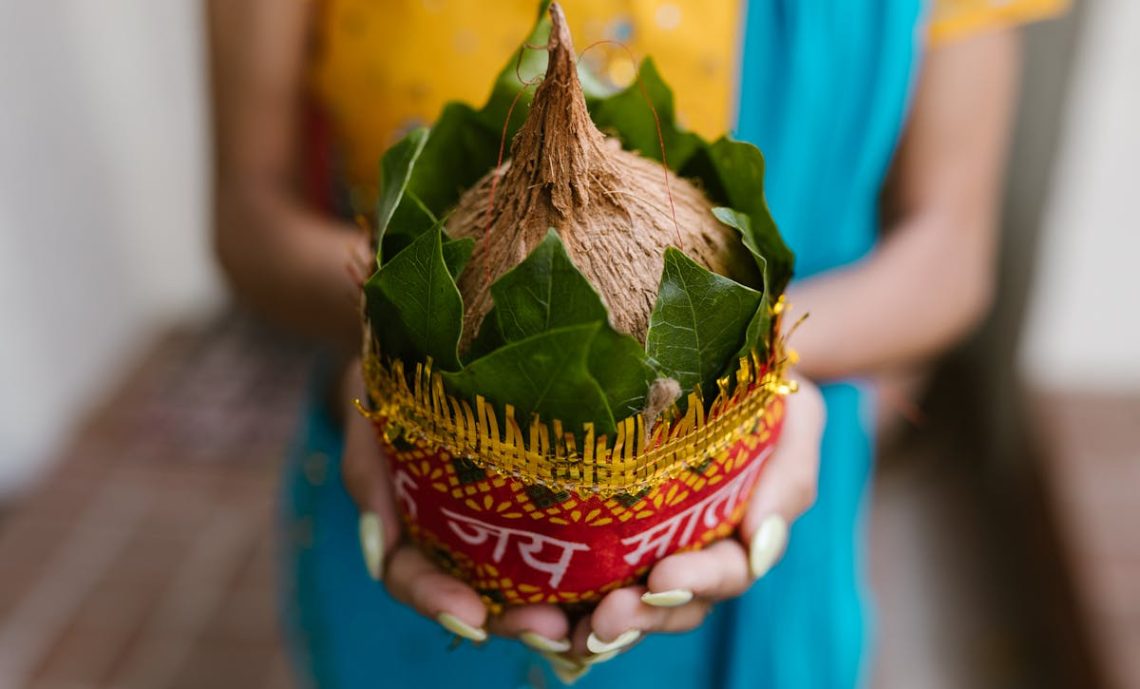
A kalash or sacred pot is established as part of the worship, with the exact ritual procedure varying according to regional and family traditions.
The timing is important in many traditions and is calculated according to the local Hindu calendar.
People observing Ghatasthapana should therefore check the local panchang for the correct time.
Navratri Fasting and Food
Fasting is an important part of Navratri for many devotees.
The rules are not identical across India. Some people observe a strict fast, while others eat specific foods considered suitable for fasting.
Common fasting foods include:
- Sabudana khichdi
- Sabudana vada
- Kuttu or buckwheat preparations
- Singhara flour dishes
- Rajgira or amaranth preparations
- Fruits
- Potatoes
- Peanuts
- Milk
- Curd
- Other dairy products
Fasting rules can vary by family, region and religious tradition.
There is no single Navratri fasting menu followed throughout India.
What to Wear During Navratri 2026
If you follow the popular nine colour tradition, the 2026 colours are:
| Date | Colour |
|---|---|
| October 11 | Orange |
| October 12 | White |
| October 13 | Red |
| October 14 | Royal Blue |
| October 15 | Yellow |
| October 16 | Green |
| October 17 | Grey |
| October 18 | Purple |
| October 19 | Peacock Green |
The colour custom is particularly visible in Gujarat and Maharashtra.
For Garba events, traditional Gujarati clothing such as chaniya choli and kediyu is commonly seen.
For temple visits, visitors should follow local rules regarding clothing, footwear and photography.
Best Places to Experience Navratri in India
| Place | What to experience |
|---|---|
| Ahmedabad, Gujarat | Garba and community celebrations |
| Vadodara, Gujarat | Garba and Dandiya |
| Kolkata, West Bengal | Durga Puja |
| Cuttack, Odisha | Durga Puja |
| Mysuru, Karnataka | Mysuru Dasara |
| Tamil Nadu | Golu |
| Kerala | Saraswati worship and Vidyarambham |
| Delhi and North India | Ramlila and Dussehra |
| Maharashtra | Navratri worship, Garba and Dandiya |
| Gujarat’s Umiya Mata Temple, Unjha | Navratri worship and Garba |
For travellers, the best destination depends on the type of celebration they want to experience.
Choose Gujarat for Garba and Dandiya, Kolkata for Durga Puja, Mysuru for Dasara, Tamil Nadu for Golu traditions and Kerala for Saraswati worship and Vidyarambham.
Navratri 2026 Travel Tips
If you plan to travel during Navratri, check the local festival programme before making arrangements.
Celebrations can range from small temple ceremonies and household traditions to major public events.
Large celebrations can affect:
- Traffic
- Hotel availability
- Restaurant availability
- Local transport
- Access to festival venues
- Entry to temples and religious sites
For Garba and Dandiya events, check whether registration or tickets are required.
For Durga Puja pandals, allow extra time for crowds.
For temples and religious sites, follow local rules regarding footwear, photography and dress.
If you are visiting a festival specifically for photography, check the local rules before carrying professional equipment.
Navratri 2026 FAQs
When is Navratri 2026?
Navratri 2026 begins on October 11 and ends on October 19, 2026. Vijayadashami or Dussehra is on October 20.
What are the Navratri colours for 2026?
The popular 2026 sequence is Orange, White, Red, Royal Blue, Yellow, Green, Grey, Purple and Peacock Green.
When does Navratri start in 2026?
Navratri starts on Sunday, October 11, 2026.
When does Navratri end in 2026?
The nine day Navratri observance ends on Monday, October 19, 2026. Vijayadashami follows on October 20.
Why do Navratri colours change every year?
The popular colour system links the first colour to the weekday on which Navratri begins. Since the starting weekday changes each year, the colour sequence can also change.
Are Navratri colours the same throughout India?
No. The nine colour clothing tradition is a popular regional custom, especially associated with western India. Different communities and sources may use different colour associations.
What is the difference between Navratri and Durga Puja?
Navratri is a nine night festival associated with Goddess Durga and Shakti. Durga Puja is a major regional celebration centred on Goddess Durga, particularly prominent in eastern India.
Is Dussehra part of Navratri?
Dussehra or Vijayadashami follows the nine day Navratri observance. In 2026, Navratri ends on October 19 and Vijayadashami is on October 20.
What are the nine forms of Goddess Durga?
The nine forms are Shailaputri, Brahmacharini, Chandraghanta, Kushmanda, Skandamata, Katyayani, Kalaratri, Mahagauri and Siddhidatri.
What is Ghatasthapana?
Ghatasthapana is a ritual associated with the beginning of Navratri. A sacred kalash is established as part of the worship. The exact ritual and timing vary according to regional and family traditions.
What food is eaten during Navratri fasting?
Common fasting foods include sabudana, buckwheat, amaranth, fruits, potatoes, peanuts and dairy products. Fasting rules vary by family and regional tradition.
Where is Navratri celebrated in India?
Navratri is celebrated across India, with different regional forms. Gujarat is known for Garba and Dandiya, West Bengal for Durga Puja, Karnataka for Mysuru Dasara, Tamil Nadu for Golu and Kerala for Saraswati worship and Vidyarambham.
Is Garba part of Navratri?
Yes. Garba is one of the best known Navratri traditions of Gujarat. UNESCO inscribed Garba of Gujarat on its Representative List of the Intangible Cultural Heritage of Humanity in 2023.
Is Durga Puja part of Navratri?
Durga Puja takes place during the same autumn festival season and is closely connected with Navratri traditions, particularly in eastern India. UNESCO inscribed Durga Puja in Kolkata on its Representative List of the Intangible Cultural Heritage of Humanity in 2021.
What is celebrated on the tenth day after Navratri?
The tenth day is Vijayadashami, also called Dussehra. Different regions connect the day with different traditions, including the victory of Rama over Ravana and the victory of Goddess Durga over Mahishasura.
Takeaway
Navratri 2026 begins on October 11 and ends on October 19, followed by Vijayadashami on October 20. The popular nine colour sequence for 2026 is Orange, White, Red, Royal Blue, Yellow, Green, Grey, Purple and Peacock Green. But Navratri is much more than a colour calendar.
In Gujarat, the festival is closely associated with Garba and Dandiya. In West Bengal and Odisha, Durga Puja takes centre stage. Mysuru celebrates the season through Dasara, Tamil Nadu through Golu, Kerala through Saraswati worship and Vidyarambham, while many parts of North India connect the period with Ramlila and Dussehra.
The dates may be the same, but the way Navratri is experienced can be very different from one part of India to another. For anyone planning to celebrate or travel during Navratri 2026, understanding these regional differences makes the festival easier to appreciate and experience respectfully.
Sources

Khushi Jha
I am Khushi Jha, a proud alumna of Delhi University with a degree in History and Political Science. My fascination with the events that have shaped our world drives me every day. Currently, I am pursuing my Master’s in History, diving even deeper into global dynamics and the incredible heritage of India. I firmly believe that India's rich heritage deserves wider recognition. I strive to bring its stories to the forefront, ensuring they are celebrated and acknowledged on a global stage. I have written extensively across various niches, including fashion, health, lifestyle, real estate, hospitality, amongst others. In my free time, you’ll find me immersed in books, both fiction and non-fiction, or simply enjoying some much-needed rest.

You May Also Like
Moatsu Festival 2025: A Celebration of Ao Naga Culture in Nagaland
Excavation at Pattanamarudur Set to Begin in January 2026: What to Know